
John Austin was cursed with famous friends, among them Jeremy Bentham, Thomas Carlyle, James Mill and Mill's son John Stuart, whom Austin tutored in the law. Cursed because, while they were all impressed by his intellect and predicted he would go far, he did not. His nervous and depressive disposition combined with his ill-health lead to his failure as a lawyer, an academic, and as a government official. In 1832, Austin wrote The Province of Jurisprudence Determined, which almost no one read and promptly went out of print. Almost thirty years after his death, his widow published a second edition. This time, everybody read it.
Austin is considered the first positivist. Positivism is so-called because the law, on this account, is a "posit." That is, all law is human-made, separate from morality, and identifiable as law by the details of how it came about – and (most importantly) the fact that the source of law is habitually obeyed. Positivism aspires to be an empirical approach to the law. So, Austin says laws are rules, but, empirically, are also a species of command.
Wednesday, February 26, 2025
What is Law?

Wednesday, December 11, 2024
Not all is well inside the Taliban

On August 21, a strict public morality law was issued in Afghanistan. The 114-page document outlining the legislation contains provisions that cover transportation, media, music, public spaces and personal conduct. Among its most restrictive provisions are a ban on music and on women singing or reading aloud in public.
The announcement of the law provoked widespread condemnation internationally and raised questions about the direction in which the Taliban government is taking Afghanistan given past promises to ease restrictions on women.
Tuesday, November 12, 2024
The Proposed Constitutional Court for Sri Lanka
Presentation made at the National Law Summit held on 30th July at Monarch Imperial Hotel. The participants exceeding 1000 consisted of Ambassadors, Party Secretaries, Lawyers, Professors, Academicians, Members of Parliament and Civil Society Leaders.


Some consider it as one of the most successful improvements
on the traditional European, parliament-oriented concepts of democracy and the
rule of law.
It exists in about 85 countries around the world. Out of 27
EU nations, 16 have Constitutional Courts. Became popular between 1945-56 in
Austria, Germany and Italy. It is used in South Africa, Spain, Indonesia,
Thailand and South Korea. Under 1972 Constitution Sri Lanka had a
Constitutional Court but many have raised questions whether it was a real court
with adjudicative powers.
Jurist and Legal Philosopher Kelson played a key role in
setting up in Austria. Federalism remains a key aspect of Austrian
constitutional adjudication to this day while the constitutional court
continues to serve as an irreplaceable pillar of federalism in the framework of
Austrian constitutional law.
PURPOSE
The purpose of a Constitutional Court is to review laws, and
usually also executive acts and decisions, to decide whether hey are
constitutionally valid and provide a remedy in cases where they are not. It
would be an exclusive power of the
Constitutional Court.
Unlike traditional courts, constitutional courts can often
perform abstract reviews of laws as well as concrete reviews.
Abstract review may be a priori (before
a Bill is promulgated as law) or a posteriori (after
a Bill becomes law).
A vital area is for the court to be empowered to perform
post-enactment review. Post-enactment reviews were seen under
the Soulbury Constitution in 1946 but removed under the 1972
Republican Constitution.
Post-enactment review is seen in India -Articles 13.32.131 and
South Africa 172.
COMPOSITION, POWERS, STANDING AND CHALLENGES
- Fixed
term or permanent appointment?
- Inclusion
of foreign judges
- Inclusion
of academics
POWERS
All constitutional courts share the core power to invalidate
legislation deemed incompatible with the Constitution.
- The
power to strike down laws
- The
power to suspend a declaration of invalidity
STANDING
A citizen should be able to question the validity of any
executive or legislative act which includes an act that is claimed
to infringe a fundamental right on the grounds of
inconsistency with any provision of the Constitution.
In Sri Lanka today the Supreme Court shall have sole and
exclusive jurisdiction to determine any question as to whether any Bill or any
provision thereof is inconsistent with the Constitution. It shall have sole and
exclusive jurisdiction to hear and determine any question relating to the
interpretation of the Constitution. Lower courts
have no power to address constitutional matters.
Challenges to a Constitutional Court: In addressing
‘transitional justice’ questions, such as assessing the validity of amnesty
laws or the validity of trials of former regime officials, and assessing the
constitutionality of laws
passed by the previous regime. In implementing changes
in courts the best approach in the current climate is
to embrace “constitutional incrementalism”
rather than dramatic change.


Click to read in e-Journal
Wednesday, September 18, 2024
An ‘embarrassment’: Experts explain what could happen as Switzerland rejects landmark climate ruling

Five months after the judgment, the Federal government said that it has fulfilled the policy requirements of the ruling.
An unprecedented ruling from the European Court of Human Rights (ECtHR) in April made protection from the effects of climate change a human right under European law.
Brought by a group of elderly women, the case was directed at Switzerland with the court finding the country's insufficient action to tackle greenhouse gas emissions was a breach of human rights.
The landmark judgment was heralded as a breakthrough for climate cases in Europe and around the world. As the first instance of a country being held legally responsible on this issue, it set a precedent that many are hoping will mean success in future climate cases.
What was in the ruling and how did Switzerland respond?
The ECtHR didn't explicitly tell Switzerland what it had to do next to tackle climate change, just that it had to do more.
First, Switzerland's parliament voted to reject the ECtHR's ruling in June. It said it was not "ignoring" it but that the country already had an effective climate strategy.
Friday, August 9, 2024
SIXTH SOUTH ASIAN PEOPLES SUMMIT DECLARATION 2007
As a member of the drafting team, I am happy to upload a copy of this declaration.


Thursday, July 18, 2024
Breaking: International Criminal Court issues arrest warrants for Russia's Shoigu, Gerasimov

Shoigu served as Russia's Defense Minister at the time of the alleged crimes. Shoigu was replaced in May by Andrei Belousov, a former economy minister with no previous military experience, after serving as defense minister since 2012.
Shoigu and Gerasimov are charged with the war crimes of "directing attacks at civilian objects," "causing excessive incidental harm to civilians or damage to civilian objects," and the "crime against humanity of inhumane acts."
The charges relate to Russian strikes on Ukraine's energy infrastructure between October 2022 and March 2023, the ICC said.
Monday, June 17, 2024
Putin’s designs on a Baltic island are leading Sweden to prepare for war

Gotland has been a popular holiday destination for decades, but recently Swedish commander-in-chief, Mikael Bydén, claimed that Russian president Vladmir Putin "has his eyes" on the island. Concern was further ramped up, showing Gotland was just one part of Russia's ambitions in the Baltics, in the last few days when Russia published a document suggesting that it needed to reassess the maritime borders in the Gulf of Finland.
That draft decree by the Russian defence ministry, which has since been removed, proposed that Russia wanted to revise its borders with Finland and Kaliningrad (based on a resolution adopted by the Soviet Union's council of ministers in 1985) and expand its territorial waters.
Sunday, June 2, 2024
The legal profession in 2024: AI

Can you envision a time when clients in need of legal assistance can turn to AI, instead of lawyers, for help, at least in more routine private law matters like divorces or smaller lawsuits? Maybe the plaintiff's AI talks to the respondent's AI and to the judge's AI and the various AIs sort everything out without the humans needing to get too deeply involved. I'm half joking, but then again, did the horse and buggy manufacturers immediately understand the implications of the automobile?
Monday, April 29, 2024
Leaked State Department Memo: Israeli Assurances 'Neither Credible Nor Reliable'

A newly leaked internal memo shows that officials at four U.S. State Department bureaus don't believe the Israeli government's assurances that it is using American weaponry in Gaza in compliance with international law, rejecting them as "neither credible nor reliable."
The memo, first reported by Reuters on Saturday, is a joint submission from the State Department's bureaus of Democracy, Human Rights, and Labor;
Population, Refugees, and Migration; Global Criminal Justice; and International Organization Affairs.
Tuesday, March 5, 2024
The Supreme Court's 'Immunity Club' And The Advent Of Fascist Jurisprudence
I just watched a full hour of some very, very smart legal eagles analyzing what it means that the Supreme Court has decided to hear Donald Trump's immunity appeal. Six experts were interviewed by Nicole Wallace on MSNBC. She's good. Every one of the experts was good. The whole show did an excellent job of running through all the permutations and combinations of what it could mean that the Supreme Court will hear oral arguments of the Trump appeal on April 22, and what that could mean in terms of when they might issue a decision, and what that would mean about when the case before Judge Tanya Chutkan might come to trial.
I don't care how you cut it, this is the terrifying result you get when you elect a raving fascist lunatic like Donald Trump and he gets the opportunity – aided and abetted by right wing puppets in the Senate and their right-wing corporate puppeteers – to appoint a gaggle of starry-eyed authoritarian moonies to the highest court in the land. It takes only four justices for the Supreme Court to agree to hear a case. We learned today that four of the justices who went through the authoritarian training camp run by the Federalist Society, which is backed by a small group of fascist billionaires, got together and decided to hear Trump's case, which makes the absurdly authoritarian claim that he, and he alone, is above the law.
Justice Clarence Thomas, whose wife participated in Trump's conspiracy to overturn the 2020 election, has been supported monetarily by one of the right-wing billionaires that funds the Federalist Society. Although the court didn't announce the names of the justices who voted to take the Trump case, it is a certainty that Thomas was one of them. The other three are no better, because all six of the Republican appointed justices attend Federalist Society private functions, they give speeches to Federalist Society gatherings, they hire clerks approved by the Federalist Society.

Sunday, January 7, 2024
Israel Is Terrified the World Court Will Decide It’s Committing Genocide

Israel Is Terrified the World Court Will Decide It's Committing Genocide
For nearly three months, Israel has enjoyed virtual impunity for its atrocious crimes against the Palestinian people. That changed on December 29 when South Africa, a state party to the Genocide Convention, filed an 84-page application in the International Court of Justice (ICJ, or World Court) alleging that Israel is committing genocide in Gaza.
South Africa's well-documented application alleges that "acts and omissions by Israel … are genocidal in character, as they are committed with the requisite specific intent … to destroy Palestinians in Gaza as a part of the broader Palestinian national, racial and ethnical group" and that "the conduct of Israel — through its State organs, State agents, and other persons and entities acting on its instructions or under its direction, control or influence — in relation to Palestinians in Gaza, is in violation of its obligations under the Genocide Convention."
Saturday, December 9, 2023
Henry Kissinger, War Criminal Beloved by America’s Ruling Class, Finally Dies

Henry Kissinger died on Wednesday at his home in Connecticut, his consulting firm said in a statement. The notorious war criminal was 100.
Measuring purely by confirmed kills, the worst mass murderer ever executed by the United States was the white-supremacist terrorist Timothy McVeigh. On April 19, 1995, McVeigh detonated a massive bomb at the Murrah federal building in Oklahoma City, killing 168 people, including 19 children. The government killed McVeigh by lethal injection in June 2001. Whatever hesitation a state execution provokes, even over a man such as McVeigh — necessary questions about the legitimacy of killing even an unrepentant soldier of white supremacy — his death provided a measure of closure to the mother of one of his victims. "It's a period at the end of a sentence," said Kathleen Treanor, whose four-year-old McVeigh killed.
Sunday, October 1, 2023
‘Truly a David and Goliath case’: Six young people take 32 countries to court in unprecedented case

The European Court of Human Rights will hear an "unprecedented" lawsuit on Wednesday, brought by six young people against 32 European countries accusing them of failing to tackle the human-caused climate crisis.
The claimants, between ages 11 and 24 and all from Portugal, will argue that they are on the frontlines of climate change and ask the court to force these countries to rapidly accelerate climate action.
It is the first climate case to be filed with the European Court of Human Rights and is the largest of a total of three climate lawsuits the court is hearing.
Sunday, August 20, 2023
India’s supreme court issues handbook against use of archaic terms for women

India's supreme court has issued a handbook for judges urging them to shun words like seductress, vamp, spinster and harlot when talking about women.
Archaic terms that disparage women and perpetuate gender stereotypes can still be routinely heard in Indian courts long after falling into disuse in other countries. It is not unusual for a wife to be described as chaste or ladylike, and sexual harassment is routinely trivialised as "Eve-teasing".
The supreme court said its Handbook on Combating Gender Stereotypes was aimed at ensuring that "legal reasoning and writing is free of harmful notions about women".
Saturday, August 12, 2023
Illinois Supreme Court upholds state’s ban on semi-automatic weapons
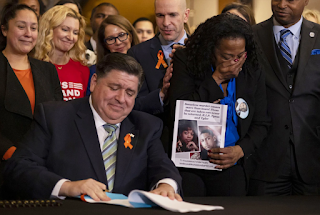
In a 4-3 decision Friday, the high court found that the Protect Our Communities Act does not violate the federal Constitution's guarantee of equal protection of the law nor the state constitution's bar on special legislation.
The court also decreed that state Rep. Dan Caulkins, a Decatur Republican, and like-minded gun-owners who brought the lawsuit had earlier waived their claims that the law infringes on the Second Amendment to own firearms and could not raise it before the Supreme Court.
Monday, July 10, 2023
Israel does not have a right to self-defense for its occupation

As Israel was invading and bombing Jenin this week, AIPAC was pumping out a simple message: "Israel is right to protect its citizens from terrorism." Others echoed the same line, often including the false theory that Iran—which supports and backs Palestinian armed militant groups such as Hamas and Islamic Jihad—actually controls the Palestinian resistance, implying, ridiculously, that but for Iranian malfeasance, Palestinians wouldn't be fighting against Israel's occupation.
Israel's message from its own leaders makes the same case, with slightly different language. Opposition leader Yair Lapid, for example, put it this way: ""Our children are being slaughtered, and Israel has every right on earth to defend itself, and we from the opposition support the Israeli defense forces and the Israeli government on this matter." Lapid made that statement in English, meaning it was the version of Israel's message that was meant for foreign audiences, particularly Americans.
Click to read
Sunday, April 16, 2023
Harvard negotiator explains how to argue
Arguments are a necessary part of life, but they don't necessarily have to be fraught. Psychologist Dan Shapiro has identified three barriers to productive arguments: an us-versus-them identity, not showing appreciation, and a lack of affiliation. Breaking through these barriers requires us to be better listeners and to recategorize our sense of "us."
I hate arguments. I hate the way it feels when my blood pressure rises and the cortisol kicks in. I hate the frustration that comes from talking past one another or reaching an impasse on an important issue. I especially hate the awkward apologies I have to dole out the morning after — because I definitely shouldn't have said that, and yes, it was a cheap shot.

Saturday, December 24, 2022
Supreme Court overturns Roe v. Wade, ending 50 years of federal abortion rights

The Supreme Court in a 6-3 decision on Friday overturned Roe v. Wade, the landmark ruling that established the constitutional right to abortion in the U.S. in 1973.
The court's controversial but expected ruling gives individual states the power to set their own abortion laws without concern of running afoul of Roe, which for nearly half a century had permitted abortions during the first two trimesters of pregnancy.
Almost half the states are expected to outlaw or severely restrict abortion as a result of the Supreme Court's decision. Other states plan to maintain more liberal rules governing the termination of pregnancies.
Friday, August 19, 2022
Britain has a decision to make: the rule of Boris Johnson – or the rule of law?
Don't succumb to Johnson derangement syndrome, they tell us.Stay calm. Keep a sense of proportion. Don't get carried away. As a matter of self-care, that might be good advice for those at risk of bursting a blood vessel in their rage at this government and its leader. But learning to shrug off Boris Johnson's conduct carries risks of its own. It can mean missing, or underreacting to, acts that merit furious opposition – such as when, before our very eyes, the prime minister destroys the principle that sits at the very foundation of a free society, a principle first codified in this country eight centuries ago and without which a life free of fear is impossible. I'm talking about the rule of law.

Thursday, June 2, 2022
Why Johnny Depp lost his libel case in the UK but won in the US
The outcome of the Johnny Depp defamation trial turned a bit of celebrity jurisprudence on its head — the long-standing conventional wisdom that it's easier for a VIP to prevail with a libel claim in the United Kingdom than in the United States.
The reason, according to legal experts, may simply boil down to the fact that Depp's action against his ex-wife Amber Heard in the UK — which he lost — happened to be decided by a judge, whereas his case in the United States was decided by a jury.
"The answer is simple," said George Freeman, executive director of the Media Law Resource Center. "It was up to the jury."
